The Joyful Art of Derrick Harris

In a recent article for Litro I wrote about second-hand bookshops, those “pubs for the mind”. The essay was called Just Browsing and contained a brief reference to the illustrator Derrick Harris. I first became aware of his work when I picked up an odd but entertaining old book called Word for Word, An Encyclopaedia of Beer. I was intrigued by the jargon of the brewing industry. But it was the illustrations – small black and white wood engravings, bold and jaunty, with sometimes sinister flourishes – that really caught my attention. I was in the excellent Carnforth Bookshop at the time, nosing my way through a succession of creaking rooms, all crammed with books. I believe it was a birthday expedition, a couple of years ago perhaps. (The messy all-dayers and frazzled nightclubs of curly-haired youth had long been superseded by sedate railway journeys across the north country.)

Carnforth is, of course, famous for its railway station, central to Brief Encounter. Carnforth itself seemed a rather desolate place – at least it appears as such in my untrustworthy memory, a place of wide corners and sloping roads to nowhere. The pubs were uninvitingly big and menacingly empty, with screens glowing in the gloom. There was, however, an excellent little bar serving real ale at the station. I hope it is still there.

The bookshop where I discovered Harris was an endless warren of rooms and sub-rooms. It was almost overwhelming. A few solid hours of browsing lay ahead. I heard a voice. “Relax, take your time. You’ll find some good stuff here. It’s only a matter of time.” The voice was in my head. In such a promising bookshop one almost feels it a duty to leave with armfuls of treasure. But my haul was meagre. A copy of Wolf Mankowitz’s My Old Man’s a Dustman, “the story of a Cockney Don Quixote and his Sancho Panza”. From the flyleaf: “In this story Wolf Mankowitz uses the Cockney idiom with immense relish, making the most of its audacity and gorgonzola ripeness.” How could I resist? I still haven’t read it, I don’t know why. It draws me in. I’ve taken it off the shelf to have a look. It has a nice jacket, designed by Sydney Mould, with an attractive, trembly illustration of the Cockney duo making their way across a rubbish tip.

There were a few William Sansoms to be had in the shop but I considered them overpriced. In the age of the internet everyone’s an expert. So I left with two slim volumes, the Mankovitz and Word for Word. I took them home on the train as Cumbria and then Lancashire darkened through the windows.

A few months later I looked up Derrick Harris. There wasn’t much to be found on the internet. I contacted his Estate. A little later I was invited by Catalina Botello to view the archive. It was an immense privilege to meet Harris’s widow, Maria. She sat with a jigsaw on her lap as she told me of her life with Derrick. It was a delight to see Harris’s sketches and doodles, his homemade Christmas cards, his imposing ink-stained woodblocks. It was a bright day in early summer when I visited Catalina and Maria, a day of glinting windows and halting traffic. Workmen yelled. Students meandered in and out of grand-looking buildings. A woman in huge sunglasses carried a tiny dog in her arms. A boy dropped his ice lolly and let out the most awful squeal of anguish. It was a Derrick Harris kind of day, full of interest and charm and human mischief.

I wrote an essay on Harris, Inspired by the Day, also published by Litro. I’m heartened by the positive response it’s had, with people curious to know more about Harris, to see more of his work. People do seem to warm to his images. Perhaps his time has come at last. It would be wonderful to see an exhibition of his work in the UK. At one time there were plans, I believe, to include Harris in the Design series of books, joining such figures as Abram Games, Edward Bawden, E. McKnight Kauffer, David Gentleman and Peter Blake. Harris’s delightful colour illustrations for a children’s book, Royal Flush, remain without a story.

For more information on Derrick Harris, please visit: www.derrick-harris.com

All images copyright The Estate of Derrick Harris.


Lambert Flows

A few weeks ago I had the pleasure of reading my work at the International Anthony Burgess Foundation in Manchester. If you haven’t been, you should. I was merely a warm-up nonentity before the main attraction, Magnus Mills, a tall and genial fellow in a noticeable shirt. He looks like Syd Little and sounds like Tommy Cooper. He  entertained the crowd with  a selection of droll readings, my favourite being a telephone interaction between a less than forthcoming grocer and an increasingly exasperated customer. Mills himself likened it to a Python sketch. He was very good.  But let’s return to the nonentity.  I read from a work in progress. The piece seemed to acceptable to a boisterous crowd hungry for Mills. Indeed, nothing unsavoury was hurled in my direction. Does that count as success?

Jamie Stewart reviewed the event for Humanity Hallows. I was pleased to see what he’d written:

“Lambert flows through Dublin,” Stephen Hargadon begins as he kicked off the night with the equally hilarious and gruesome story of a “faded, rather hairy pop-star from the 1960s, who hides himself away in the West of Ireland.” It’s hard to listen to Hargadon’s prose without feeling Dublin around you, hearing the river and the voices curl nearby. “Lambert is observing, listening, walking.” Hargadon’s ear for city sounds is both disarming and utterly charming. Hargadon has previously had his work published in Black Static and Popshot.”

To be pedantic, Lambert was strolling, not flowing, through Dublin. But no matter. My dulcet tones, combined with a dry mouth, probably led to the confusion. Indeed, it was a happy mistake. I rather like the idea of Lambert flowing through Dublin like the Liffey. Constructive criticism at its finest. (BS Johnson thought critics a waste of space unless they could suggest improvements.)  As for the dry mouth, there must have been something in the air that night, for Magnus Mills reached for his glass of water several times to pacify a mutinous throat.

An enjoyable and instructive evening for all concerned.

The Toilet

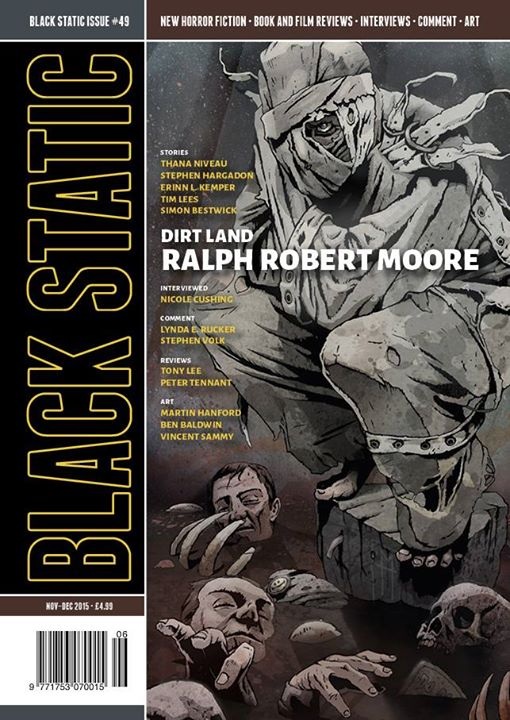
November, month of thrown fireworks and burning effigies,  will see issue 49 of Black Static magazine landing on doormats across the country.  It’s certainly better than having a banger stuffed through your letterbox. This issue features a 13,000 word offering, Dirt Land, by Ralph Robert Moore, while Martin Hanford provides the cover art.

Black Static 49

This issue includes a story of mine called  The Toilet. It’s my fourth story to feature in Black Static, following on World of Trevor, The Bury Line and The Visitors. As a magazine, it’s a broad church. Readers who might think it restricted to blood and guts and rampaging fiends should take a closer look. There’s a real variety of writing to be found,  detailing our many modes of terror, disquiet, pain, grief, loss, our human vulnerability.

World of Trevor, my first short story to be published anywhere, appeared in Black Static 42. So to have another story in the magazine feels rather like coming home, if that’s not too presumptuous a comment.

I’m looking forward to seeing the artwork.  I hope you enjoy your visit to The Toilet.

Take out or eat in


Hollywood Chicken: a new story

“Happens to me quite a bit. People think they know me. Perhaps they do. I wouldn’t know. I’m not a people person.”

Hollywood Chicken was published in issue two of LossLit Magazine and can be read in full here.

LossLit is an attempt by its co-creators, Kit Caless and Aki Schilz, to explore the various influences of loss in literature. The project aims to produce a body of work that will look at loss from all angles, alongside its online micro-project, the #LossLit hashtag on Twitter. Find out more at losslit.com.

Each contributor is asked to pick a book concerned with loss. You can read about my choice in the magazine.

Enjoy the story. And don’t forget to clean up after yourself.

Austerity Horror

In a recent review of Black Static 45, writer Tom Johnstone referred to ‘austerity horror’, a term I had not encountered before. It’s an interesting if unsurprising idea: that economic and social stagnation creates a climate of fear, contingency, instability, moral squalor. It is certainly true that poverty is increasingly seen as a contagion, or a self-imposed aberration, one that must be purged or punished but never cured. Or else poverty serves to entertain us on television. One could argue that these modes and attitudes are not confined to periods of ecomonic sluggishness: even the so-called boom times are rife with filth and degredation. That’s how money is made.

Social paranoia, corporate deceit, and institutionalised sexual corruption, combined with startling technological advances and new modes of communication, are providing fertile territories for a new generation of writers, especially short story writers. The best of this writing is usually oblique or ambiguous. Fiction will push towards more imaginative modes and forms, because reality itself is being fictionalised. Or debased. Or internalised. “Electronic aids,” said Ballard, “particularly domestic computers, will help the inner migration, the opting out of reality. Reality is no longer going to be the stuff out there, but the stuff inside your head. It’s going to be commercial and nasty at the same time.”

Tom Johnstone’s blog can be found here: https://tomjohnstone.wordpress.com

This is what Tom Johnstone had to say about ‘The Visitors’:

‘The scene in the pub [in SP Miskowski’s story ‘The Grey Men’] where Adam fails to get through to his brother makes a nice lead-in to ‘The Visitors’, with Stephen Hargadon returning to the man-in-a-pub monologue mode of his extraordinary Black Static (and published fiction) debut ‘World of Trevor’, though it’s an internal monologue interspersed with snatches of overheard conversation rather than a chatty raconteur’s narration. His narrator’s air of garrulousness masks a solitude as profound as Adam’s in ‘The Grey Men’, and echoes Miskowski’s story in his meditation on the social changes happening around him. The apparently random final scene of supernatural retribution from a source as unique as Hargadon’s voice mirrors the narrator’s troubled past and traumatic relationship with booze, culminating in a devastatingly apt last line.’

Good eye, good ear

I was pleased to get a mention in Nicholas Royle’s introduction to Best British Short Stories 2015, published by the excellent folk at Salt:

‘In the pages of horror magazine Black Static, Stephen Hargadon loomed into view on two occasions, exploring the boozers, tower blocks and transport routes of Manchester as well as recording its voices; he has a good eye and a good ear.’

The two occasions were World of Trevor (issue 40), which you can read on this site, and The Bury Line, published in issue 42, available from TTA press.

The editor of the collection, Nicholas Royle, roamed the dark corridors, musty libraries and fragrant gardens of the literary world, uncovering gems in some unexpected places. From innumerable little magazines, academic periodicals, anthologies, collections, journals, newspapers, pamphlets, chapbooks and web sites, he plucked what he considered the year’s finest stories and brought them together in one volume. His introductory survey, engaging and shrewd, is well worth a read if you’re interested in the short story and it’s place within the current literary scene.

Authors in the anthology include Hilary Mantel, Jenn Ashworth, Helen Simpson, Charles Wilkinson, Rebecca Swirsky, Matthew Sperling, Julianne Pachico, Katherine Orr, Bee Lewis, Uschi Gatward, Emma Cleary and Neil Campbell. Check it out.

Cover art: Black Static 45

Here’s the cover of Black Static 45, with art by Richard Wagner. Out early March. (http://ttapress.com/shop/ if you’re tempted to subscribe.)

Visit the Facebook page at: https://www.facebook.com/TTAPress

Black Static 45